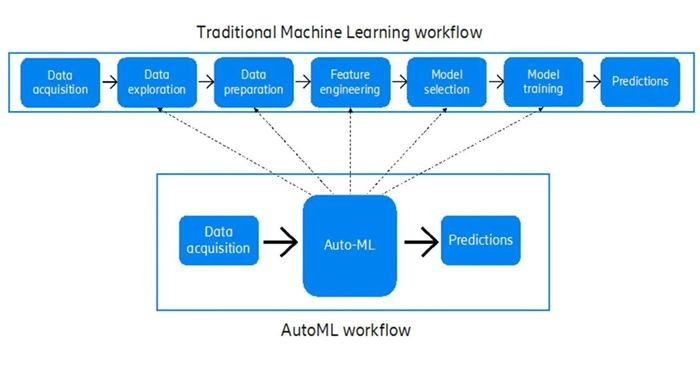

Automated Machine Learning offers techniques and procedures to make Machine Learning accessible to those who are not specialists in it, to increase its effectiveness, and to quicken the pace of Machine Learning research. Basically, Automated machine learning (AutoML) automates and eliminates manual steps required to go from a data set to a predictive model. AutoML also reduces the level of skill needed to create accurate models, allowing anyone, whether an expert or someone with little machine learning experience, to utilise it. AutoML accelerates challenging steps in the machine learning workflow by automating repeated tasks, including:
• Data exploration and pre-processing: Identify factors with a low predictive power and highly correlated that should be removed.
• Automatic feature extraction and feature selection: Choose the features with the highest predictive potential from a vast range of features.
• Model selection and tuning: Select the top-performing model by automatically tweaking model hyperparameters.
Deployment preparation: Using code generation, you may translate complex machine learning algorithms into simpler languages like C or C++ for use in embedded systems with little memory and little power.

Merits and demerits of AutoML
• Efficiency — It shortens the training period for machine learning models and speeds up and simplifies the machine learning process.
• Cost savings – A corporation can save money by allocating less of its budget to sustaining a faster, more effective machine learning process.
• Accessibility — Having a less complicated procedure enables businesses to save money on employee training or expert hire. Additionally, it opens up machine learning to a wider spectrum of businesses.
• Performance — AutoML techniques frequently outperform manually written models in terms of efficiency.
The tendency to see AutoML as a substitute for human expertise is one of its key obstacles. Like most automation, AutoML is made to carry out repetitive operations accurately and effectively, freeing up workers to concentrate on more difficult or unusual jobs. Routine operations that can be sped up by automation include monitoring, analysis, and problem detection, all of which AutoML automates. Although it is no longer necessary for a human to actively participate in the machine learning process, they should still be included in the model’s evaluation and supervision. Instead replacing data scientists and staff, AutoML should increase productivity.
The “black box” criticism of AutoML refers to the fact that machine learning algorithms can be challenging to reverse engineer. Although they increase productivity and processing capacity to create results, it might be challenging to trace the exact path taken by the algorithm to get there. As a result, it might be challenging to predict a result if a model is a black box, which makes it challenging to select the best model for a specific situation.
Several popular AutoML platforms are:
Google AutoML, a platform for automated machine learning that runs on Google’s private cloud.
Microsoft Azure Automated Machine Learning, a specialised platform running in the cloud.
Auto Keras, an open-source software library created by Texas A&M University’s DATA lab.
Scikit learn, an open source, commercially viable set of straightforward machine learning tools in Python, was replaced by Auto-sklearn, which developed from it.